
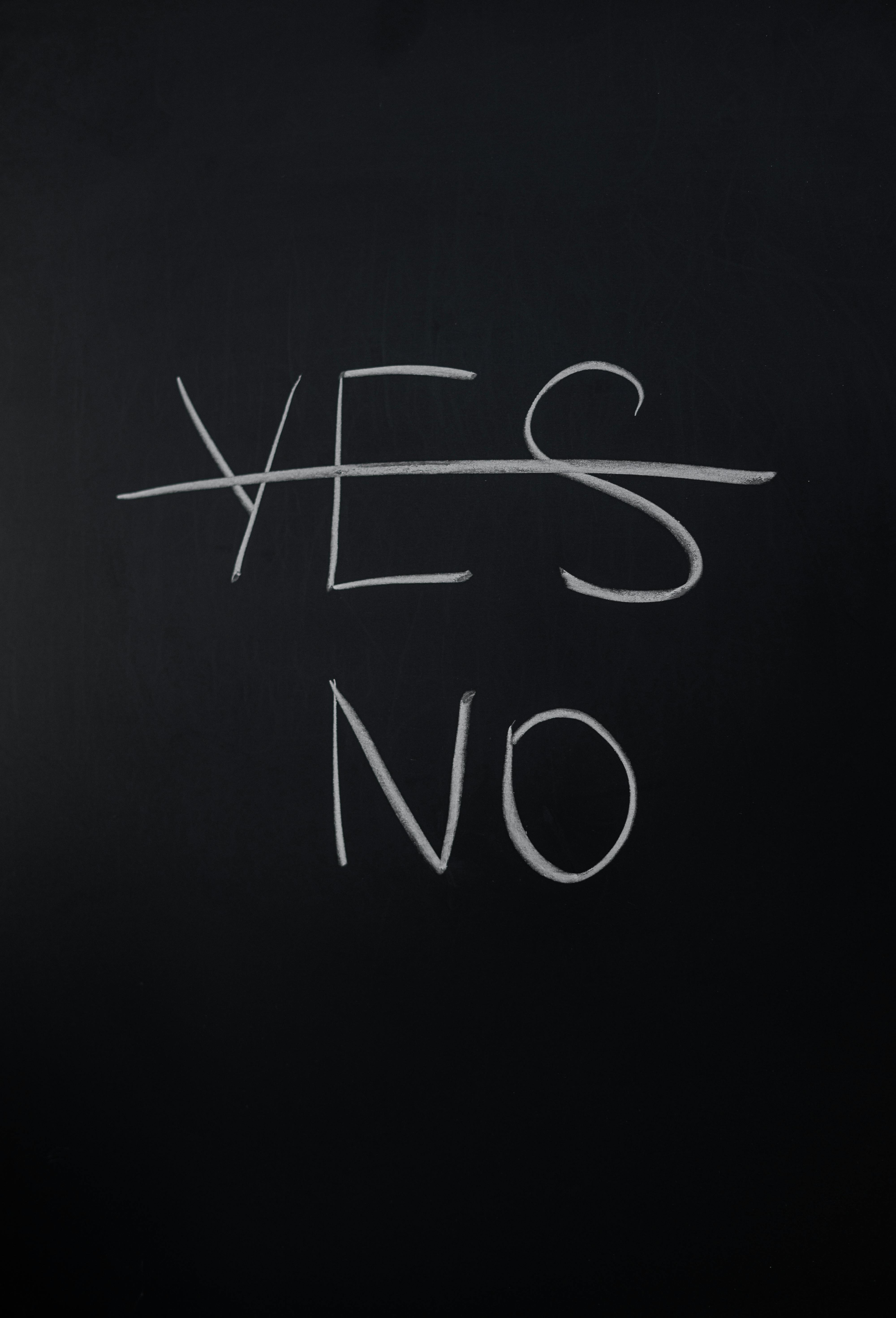
FALSE BINARY
YES OR NO IS NOT THE QUESTION

In many workplaces and in life, the problem is not that people refuse responsibility. It is that too many capable people take on more than the system can actually hold.
They are the ones who step in when something wobbles. Who agree to “just take this on as well.” Who say yes, not because they are asked, but because they see the gap and feel compelled to fill it. They believe things will fall apart if they do not. And often, in the short term, they are right.
This is where the false binary begins to operate.
It is rarely experienced as a choice between yes and no. It feels more like a choice between control and risk. Between staying in the centre of things and letting something drift. Between being the person who holds it together and becoming the one who might be seen as unavailable, disengaged, or even unreliable.
For people who are competent and invested, no does not feel neutral. It feels disruptive. Saying yes, on the other hand, preserves momentum. It keeps the system moving. It reassures others and, just as importantly, it reassures the person saying it that they are still on top of things.
Over time, this creates a familiar pattern. Projects multiply, initiatives are started with good intentions and real energy, but few are brought to completion. Attention is spread thin. Reinvention begins to replace resolution. The work looks busy, even impressive, but something essential never quite lands.
From the inside, this does not feel like overcommitment; it feels like responsibility. From the outside, it often reads as competence. The person saying yes becomes indispensable, involved everywhere, consulted constantly. And because the immediate rewards are real, the long-term cost is easy to miss.
This is not about an inability to say no. It is about the belief that saying no would mean losing control, relevance, or coherence. The yes is not generous. It is protective.
The problem is that protection comes at a price. Not immediately, but gradually, as the distance between what is taken on and what can be carried grows wider. The system keeps moving, but the person at its centre begins to fragment, pulled in too many directions to finish what they start or to recognise when agreement has stopped serving alignment.
This is where the question of yes versus no starts to miss the point entirely. The real tension is not between compliance and refusal. It is between staying recognisable to oneself and slowly becoming someone who is always saying yes, but no longer quite knows why.
Why Yes Feels Safer Than No
What makes the false binary so persuasive is that it does not operate on logic alone. It operates on wiring.
From an early age, most people learn that yes keeps them inside the group. It signals cooperation, goodwill, alignment. It smooths social exchange and lowers friction. No, by contrast, introduces uncertainty. It interrupts flow. It risks disappointment, misunderstanding, or withdrawal. Even when no is reasonable, it carries a social cost that yes does not.
Psychologically, this is not a flaw. It is adaptive. Human nervous systems evolved to prioritise belonging because exclusion once carried real danger. Saying yes, especially in ambiguous situations, reduces immediate relational risk. It reassures others and, just as importantly, it reassures the speaker that they remain acceptable, useful, and connected.
Neurologically, yes is also easier. It requires less cognitive load. Agreement allows the brain to conserve energy by following an existing path rather than creating a new one. No demands more work. It requires assessment, boundary recognition, and the willingness to tolerate potential tension. In moments of pressure or fatigue, the system defaults to what costs least in the short term, even if it is expensive later.
This is why so many people experience no as something that must be explained, even justified. A refusal feels incomplete unless it is padded with reasons, context, and reassurance. The explanation functions as a bridge back to safety, a way of saying, “I am still reasonable. I am still aligned. I am not rejecting you, only this request.” Yes needs no such defence. It simply stands on its own.
Social environments tend to reinforce this bias. Workplaces often reward responsiveness more visibly than discernment. People who say yes are seen as engaged, committed, and dependable. People who say no risk being perceived as difficult, disengaged, or uncooperative, even when their refusal is grounded in reality. Over time, the system trains its most conscientious members to absorb more than they should, not because they are weak, but because they are attuned.
This is where the cost begins to accumulate. Each yes feels small, justified, even responsible. But together they form a pattern in which capacity is mistaken for availability, and willingness is mistaken for limitlessness. The person does not feel exploited; they feel needed. And that feeling is hard to relinquish, even when it becomes unsustainable.
Understanding this bias matters because it shifts the conversation away from moral judgement. The struggle to say no is not a failure of character or confidence. It is the result of social conditioning, neurological efficiency, and a deep human preference for immediate relational safety. Until that is recognised, the false binary remains intact, and the cost of yes continues to be paid without being named.
When Resentment Appears Before Exhaustion
Resentment rarely arrives as anger. It usually arrives as a shift in posture.
At first, it is barely noticeable. A tightening when a request comes in. A flicker of irritation that is quickly overridden by reason. A sense of being needed that carries a faint aftertaste of obligation. Nothing that would justify refusal. Nothing upsetting enough to name.
Because the person is still functioning, still capable, still delivering, resentment is easy to misread. It does not even look like resistance. It looks like reliability under strain. The yes is still given, but it lands differently inside the body. What once felt aligned now begins to feel extracted.
This is why exhaustion - nowadays called burnout - is often misunderstood as a sudden collapse. The collapse comes later though. What precedes it is a gradual erosion of self recognition. The person begins to notice that their agreements no longer reflect their priorities, but they continue to honour them anyway. They keep going not because they want to, but because stopping would require admitting that something has already shifted.
Resentment, in this sense, is not hostility toward others. It is the friction that arises when behaviour drifts too far from inner consent. Each unexamined yes widens the gap just ever so slightly. Not enough to stop the system, but enough to distort the relationship a person has with their own actions and values. Over time, they are no longer fully behind what they are doing, even as they continue to do it well, and this often begins unconsciously.
This is where identity begins to change.
The person becomes more guarded, less generous in spirit, more prone to internal commentary. They may still appear engaged, but the engagement has lost its ease. What used to feel like contribution now feels like management. They start counting. Time, energy, fairness. Not because they are petty, but because something has begun to feel uneven and unsettling.
What makes this especially difficult is that resentment often conflicts with the self image of capable, principled people. They do not want to see themselves as bitter or withholding. They believe that resentment means something has gone wrong with their attitude, rather than recognising it as information. So they continue to suppress it, correct it, work around it, and keep saying yes.
By the time exhaustion openly appears, identity has already shifted. The person no longer recognises themselves in their own agreements. They may still be effective, but they are no longer fully present. Burnout, when it comes, does not mark the beginning of the problem. It marks the point at which the problem can no longer be ignored.
This is why the question is not whether one can keep saying yes. It is whether the self doing the agreeing is still intact.
I recognise this pattern because I lived inside it for far too long. I was the person who said yes reflexively, who was relied upon because refusal never came easily, and who paid a real price before learning to notice the warning signs earlier. I still prefer yes. I just no longer mistake it for responsibility.
Resentment is not a failure of character. It is a signal that alignment has been compromised. And when it is noticed early, it offers something valuable: the chance to adjust before the cost becomes irreversible.
Saying No Without Hardening
One of the reasons no feels so dangerous is that many people have only seen it used in its irritated form.
They have experienced no as abrupt, defensive, or punitive. A door slammed rather than a line drawn. So they learn, often unconsciously, that refusing requires a certain edge. That to say no, one must also withdraw warmth, patience, or goodwill. And because they do not want to become that person, they avoid no altogether.
This is where the false binary tightens its grip.
The choice begins to feel like this: either remain agreeable and accessible, or risk becoming sharp, difficult, or closed. Either say yes and stay likeable, or say no and harden. What gets lost in this framing is the possibility that refusal can come from alignment rather than irritation.
A no coming from irritation usually arrives too late. It appears after many yeses have already been given, after resentment has accumulated, after internal consent has been compromised. In that state, refusal carries charge. It sounds defensive because it is. It has to push back against pressure that has been building for a while.
A no that comes from alignment arrives earlier, and with far less force.
It does not announce itself with emphasis or justify its existence. It names a limit while there is still room for respect on both sides. There is no need to manage tone or compensate for it, because it is not reacting against anyone. It is responding to reality as it stands.
This distinction matters because many people believe they dislike saying no, when what they actually resent is having to say no too late. They associate refusal with discomfort because they have only practiced it under strain. When no is delayed until irritation is present, it inevitably carries that irritation with it.
Alignment changes the quality of the refusal.
A no spoken from alignment does not withdraw respect. It preserves it. It does not signal disengagement; it signals self-trust. And paradoxically, it is often received more easily than an overextended yes, because it does not arrive burdened with unspoken tension.
This is not about becoming rigid or unavailable. It is about recognising that clarity offered early is kinder than accommodation offered at the expense of oneself. Saying no from alignment keeps both the relationship and the person intact. It prevents resentment from having to do the boundary work later.
In that sense, no is not the opposite of generosity. It is one of its conditions.
Boundaries as Integrity Preservation
What often gets missed in conversations about boundaries is that they are not primarily about other people.
They are not tools for managing requests, expectations, or behaviour. They are measures of self-coherence. A boundary is the point at which action still matches inner consent. When that match is intact, saying yes or no does not require strain. When it is not, every decision begins to feel heavier than it should.
This is why the real cost of saying yes too often is not exhaustion at first, but distortion. A person can remain highly functional while still moving further away from themselves. Agreements continue to be honoured, tasks completed, responsibilities carried, but something subtle starts to shift. The person is still reliable, but less recognisable to themselves.
Boundaries intervene at that point.
Not as walls, but as reference points. They answer a different question than “Can I handle this?” They ask, “Is this still mine to carry?” That distinction matters, because capacity is not the same as alignment. Many capable people continue long past the moment where alignment has already been lost, precisely because they can.
Integrity lives in that difference.
It is not loud or moralistic. It does not announce itself through rigid rules. Integrity is simply the ongoing congruence between what a person agrees to and what they can stand behind without self-betrayal. When boundaries are honoured, integrity stays intact. When they are repeatedly crossed, even voluntarily, integrity begins to erode.
This erosion rarely shows up as guilt. It shows up as felt dissonance. A sense of being slightly out of place in one’s own life. The feeling that one is performing responsibility rather than inhabiting it. Over time, this dissonance becomes harder to ignore, and the person may begin to feel disconnected, irritable, or resistant without even knowing exactly why.
Boundaries prevent that drift.
They do not make someone less generous. They make generosity sustainable. They do not reduce the contribution. They ensure that what is contributed still carries the person’s full presence. When boundaries are set early and from alignment, there is far less need for resentment, withdrawal, or hard refusals later.
In this sense, saying no is not an act of self-protection against others. It is an act of loyalty to oneself. And that loyalty is what allows a person to remain open, engaged, and trustworthy over time without becoming someone they no longer recognise.
The difficulty, in the end, is not learning how to say no.
It is learning to notice the moment before resentment, before justification, before self-distance sets in. The moment when something inside you already knows that alignment is thinning, even if everything still looks fine from the outside. That moment arrives as a subtle hesitation, a pause you override, a yes that lands with less clarity than the one before it.
Most people do not lose themselves through dramatic collapse. They lose themselves through small, reasonable agreements repeated too often. Through staying helpful a little longer than is true. By confusing responsibility with availability, and generosity with self-erasure.
Saying no from alignment is not a personality change. It does not require hardness, withdrawal, or becoming someone you would not want to be. It simply restores proportion. It keeps your actions in conversation with your values. And over time, that conversation is what preserves trust — with others, but more importantly, with who you truly are.
🎶My Song for you
Decisions often don’t come easily, which makes this song perfect for this week. The Clash with Should I Stay Or Should I Go
For more good music, go to this Spotify playlist where you can find all the songs from the Change & Evolve Letters!
📚My Poem for you
Is by John Milton (1608-1674)
On His Blindness
When I consider how my light is spent
Ere half my days in this dark world and wide,
And that one talent which is death to hide
Lodg'd with me useless, though my soul more bent
To serve therewith my Maker, and present
My true account, lest he returning chide,
"Doth God exact day-labour, light denied?"
I fondly ask. But Patience, to prevent
That murmur, soon replies: "God doth not need
Either man's work or his own gifts: who best
Bear his mild yoke, they serve him best. His state
Is kingly; thousands at his bidding speed
And post o'er land and ocean without rest:
They also serve who only stand and wait."
Where do you still say yes, even though you know the more honest choice would be no?
Have a beautiful weekend, wherever it finds you.
Yours
Tanja
P.S. My podcast Change & Evolve is now available on Spotify if you’d like to explore these themes in another format.
If you’re exploring your next chapter in leadership, you can book a discovery session here: Change & Evolve - Book your conversation.
